How HMRC Taxes UK Employment Bonuses: The PAYE Mechanism
In the UK statutory tax framework, employment bonuses, profit-shares, and performance incentives are classified as earnings from employment under Section 62 of the Income Tax (Earnings and Pensions) Act 2003 (ITEPA). They are not taxed under a separate capital gains or preferential schedule. Instead, they are processed directly through your employer's standard Pay As You Earn (PAYE) payroll system:
// Realized Net Bonus Payout Equation
Net Bonus = Gross Bonus - PAYE Income Tax - Employee NI - Student Loan
// Applicable Deductions at Margin
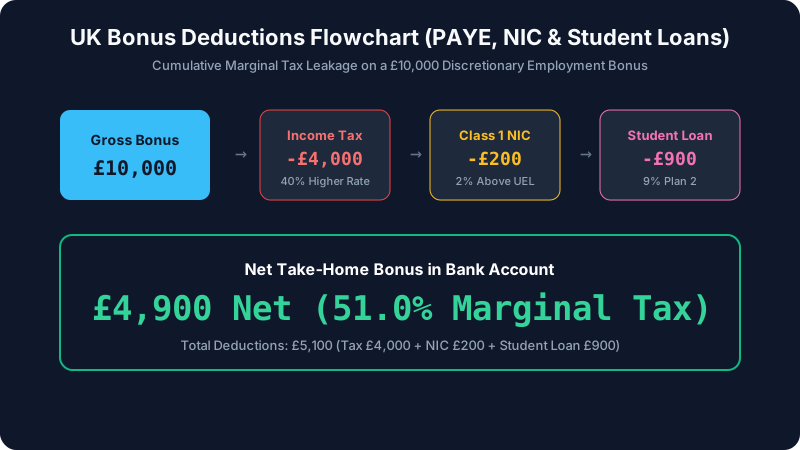
Basic Rate: 20% Tax + 8% NI | Higher Rate: 40% Tax + 2% NI | Additional: 45% Tax + 2% NI
Because PAYE computer software processes monthly earnings in isolation, receiving a large bonus in March causes the payroll software to multiply that month's earnings by 12. It momentarily assumes your annual salary has skyrocketed, pushing your bonus into the 40% Higher Rate or 45% Additional Rate band. Any excess tax deducted is automatically reconciled in subsequent monthly pay slips or via HMRC end-of-year P800 tax calculations.
The 60% Effective Marginal Tax Trap (£100,000 to £125,140)
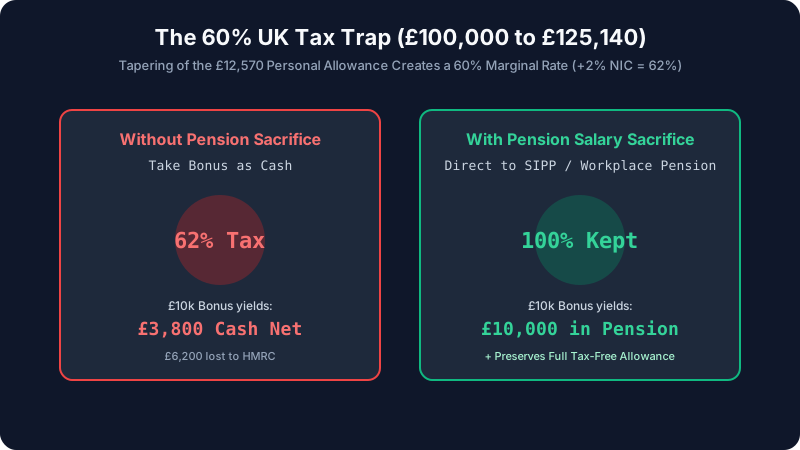
The single most punishing threshold in the entire UK tax code occurs when total earnings cross £100,000. Under Section 35 of the Income Tax Act 2007, an individual's standard £12,570 Personal Allowance is reduced by £1 for every £2 of 'adjusted net income' earned above £100,000:
Personal Allowance Reduction = (Adjusted Net Income - £100,000) / 2
Once income reaches £125,140, the Personal Allowance is completely wiped out (£0.00).
When you earn an extra £100 within this bracket, you pay £40 in Higher Rate income tax (40%). Furthermore, losing £50 of your tax-free Personal Allowance means an additional £50 of previously untaxed income is now taxed at 40%, adding another £20 of tax. The combined income tax is £60 on £100 of earnings—an effective 60% income tax rate. Factor in 2% Employee Class 1 National Insurance, and the marginal deduction reaches 62% (or 71% if repaying a Plan 2 student loan!).
Calculate UK Bonus Take-Home with BentoQuilt
Calculate your net bonus payout, compare pension salary sacrifice savings, and model student loan deductions instantly.
National Insurance & Student Loan Deductions
1. Class 1 National Insurance Contributions (NICs)
For the 2026 tax year, employee Class 1 NIC is charged at 8% on earnings between the Primary Threshold (£1,048/month) and the Upper Earnings Limit (£4,189/month). On earnings exceeding the Upper Earnings Limit, the rate drops to 2%. Because high-earning professionals receiving bonuses have already exceeded the Upper Earnings Limit in their regular salary, their bonus is typically assessed for NI at only 2%.
2. Student Loan Repayments (Plan 1, Plan 2, Plan 5 & Postgraduate)
Student loans function as a graduate payroll tax. Once your pay period income exceeds the statutory threshold, deductions are fixed percentages of all marginal earnings: 9% for Plan 1, Plan 2, and Plan 5, and 6% for Postgraduate loans. These deductions are taken from gross pay alongside PAYE.
Worked UK Bonus Case Studies: £5,000 vs. £20,000 Bonus
Case Study 1: Mid-Level Professional (£45,000 Base Salary + £5,000 Bonus)
A marketing manager in Manchester earns £45,000 and has a Plan 2 Student Loan. The £5,000 bonus pushes income to £50,000 (remaining within the 20% Basic Rate band below £50,270):
Gross Bonus: £5,000.00
PAYE Income Tax (20% Basic Rate): -£1,000.00
Employee National Insurance (8%): -£400.00
Plan 2 Student Loan (9%): -£450.00
Net Take-Home Bonus = £3,150.00 (63.0% Retained)
Case Study 2: Senior Executive Falling into the £100k Trap (£95,000 Base + £20,000 Bonus)
A technology director earns £95,000 base salary and receives a £20,000 annual performance bonus, elevating total earnings to £115,000:
First £5,000 of Bonus (£95k to £100k): Taxed @ 40% Higher Rate + 2% NI = 42% deduction (£2,100)
Next £15,000 of Bonus (£100k to £115k): Falls into 60% Personal Allowance Taper + 2% NI = 62% deduction (£9,300)
Total Deductions on £20,000 Bonus = £2,100 + £9,300 = £11,400.00
Net Cash Retained: £8,600.00 out of £20,000 (Effective Tax Rate = 57.0%)
With Plan 2 Student Loan (9%): Total Deductions = £13,200. Net Cash = £6,800 (66% lost!)
The Master Strategy: Pension Salary Sacrifice (Bonus Sacrifice)
The most effective statutory method to protect your bonus from HMRC is Pension Bonus Sacrifice. By requesting your employer divert your bonus directly into your registered SIPP or workplace pension before payroll runs:
- Zero Income Tax: You avoid the 40%, 45%, or 60% income tax deductions.
- Zero National Insurance: You save 2% to 8% in Employee NICs. Many progressive employers will also pass back their 13.8% Employer NI savings into your pension pot as an extra contribution bonus!
- Zero Student Loan Deductions: Pension contributions reduce unearned student loan reckonable income.
- Restores Child Benefit & Tax-Free Childcare: If your income crosses £60,000 (High Income Child Benefit Charge) or £100,000 (loss of 30 hours free childcare and £2,000 tax-free childcare vouchers), sacrificing your bonus preserves these valuable family welfare benefits.
UK Tax Bands & Marginal Bonus Deductions Table
| Taxable Income Band | Income Tax Rate | Employee NI | Combined Marginal Deduction (No Student Loan) | Combined with Plan 2 Student Loan |
|---|---|---|---|---|
| Up to £12,570 | 0% (Personal Allowance) | 0% | 0% | 0% |
| £12,571 to £50,270 | 20% (Basic Rate) | 8% | 28% | 37% |
| £50,271 to £100,000 | 40% (Higher Rate) | 2% | 42% | 51% |
| £100,001 to £125,140 | 60% (Allowance Taper) | 2% | 62% | 71% |
| Over £125,140 | 45% (Additional Rate) | 2% | 47% | 56% |