Direct Formula: How to Calculate Gross Profit
Gross profit is calculated by subtracting your total Cost of Goods Sold (COGS) from your Total Net Revenue over a defined accounting period. The primary mathematical equations are defined under Generally Accepted Accounting Principles (GAAP) and International Financial Reporting Standards (IFRS) as follows:
// Fundamental Accounting Equation
Gross Profit ($) = Net Revenue - Cost of Goods Sold (COGS)
// Margin Percentage Equation
Gross Profit Margin (%) = (Gross Profit / Net Revenue) × 100
Net Revenue reflects gross commercial billings minus customer trade discounts, early-payment allowances, and returned merchandise. Cost of Goods Sold represents the pure variable and direct fixed expenditures absorbed during production. If an expense persists when production halts—such as corporate headquarter rent or patent attorney retainers—it is classified as an Operating Expense (OpEx) and must never be deducted when computing gross profit.

Deconstructing COGS: What Belongs and What Must Be Excluded
Auditing errors frequently occur when non-production overhead is erroneously slipped into COGS, artificially compressing gross margins, or conversely, when direct production wages are parked in SG&A (Selling, General, and Administrative expenses) to cosmetically inflate gross profitability before institutional investors.
1. Expenditures Directly Included in COGS
- Direct Raw Materials: Physical timber, electronic microcontrollers, steel framing, pharmaceutical compounds, and primary packaging containers.
- Direct Touch Labor: Assembly-line technicians, CNC machine operators, and fabrication welders whose hours fluctuate directly with manufacturing run rates.
- Factory Utility Absorption: Three-phase industrial electricity and natural gas powering extrusion presses and assembly machinery.
- Inbound Freight & Freight-In: Customs tariffs, maritime container transport, and drayage fees necessary to deliver production inputs to the fabrication facility.
2. Expenditures Strictly Excluded from COGS (Operating Expenses)
- Commercial Marketing & Customer Acquisition: Google Ads, trade show displays, and outbound sales team commissions.
- Administrative Salaries: Executive compensation (CEO, CFO, General Counsel), HR payroll, and corporate legal expenses.
- General Corporate IT Infrastructure: Cloud CRM seats, enterprise billing software licenses, and executive laptops.
- Outbound Distribution: Last-mile courier shipping to residential consumers (categorized under Selling and Fulfillment Expenses).
Automate Corporate Profitability with BentoQuilt
Calculate gross profit, operating margin, unit economics, and markup conversions instantly with zero rounding discrepancies.
Gross Margin vs. Markup: The Critical Commercial Distinction
The single most destructive calculation error committed by contracting firms and retail enterprises is treating markup and margin as interchangeable synonyms. While both metrics quantify the financial spread between cost and sales price, their mathematical denominators originate from opposite ends of the transaction:
Gross Margin Formula
Margin = (Profit / Selling Price) × 100
Measures the percentage of each sales dollar retained as gross earnings after absorbing production costs.
Commercial Markup Formula
Markup = (Profit / Cost of Goods) × 100
Measures the percentage added on top of direct production cost to establish the retail sales quotation.
Consider a hardware unit manufactured for $50.00 COGS. If the sales manager applies a 50% markup, the unit retails for $75.00 ($50 + $25). The gross profit is $25.00. However, the realized gross margin is only 33.33% ($25 ÷ $75). If the firm operates with total SG&A overhead equal to 38% of revenue, applying a 50% markup will cause the company to lose 4.67% on every unit sold despite having an apparently positive markup.
Worked Numerical Case Studies: Manufacturing & SaaS
Case Study 1: Commercial Precision Furniture Manufacturer
Precision Timber Ltd delivers 1,200 commercial ergonomic desks during Q1 2026. Gross contract invoice volume totaled $650,000, with $20,000 awarded in early-settlement prompt pay rebates, resulting in Net Revenue of $630,000. Production ledgers record the following expenditures:
Direct Hardwood Timber & Steel Tube: $185,000
Direct Assembly Plant Wages: $115,000
Industrial Sawmill Power & Equipment Depreciation: $42,000
Inbound Freight from Timber Port: $18,000
Total COGS: $360,000
Gross Profit = $630,000 - $360,000 = $270,000
Gross Profit Margin = ($270,000 / $630,000) × 100 = 42.86%
Case Study 2: B2B Enterprise Software (SaaS) Platform
CloudScale Technologies billed $2,400,000 in Annual Recurring Revenue (ARR). In SaaS accounting under US GAAP ASC 606, COGS includes AWS infrastructure compute fees ($280,000), 24/7 Tier-1 Technical Support desk wages ($190,000), and integrated payment gateway processing splits ($60,000), totaling $530,000 in direct delivery costs. Product engineering salaries and sales bonuses are excluded as OpEx. Gross profit equals $1,870,000, achieving an enviable 77.92% gross margin.
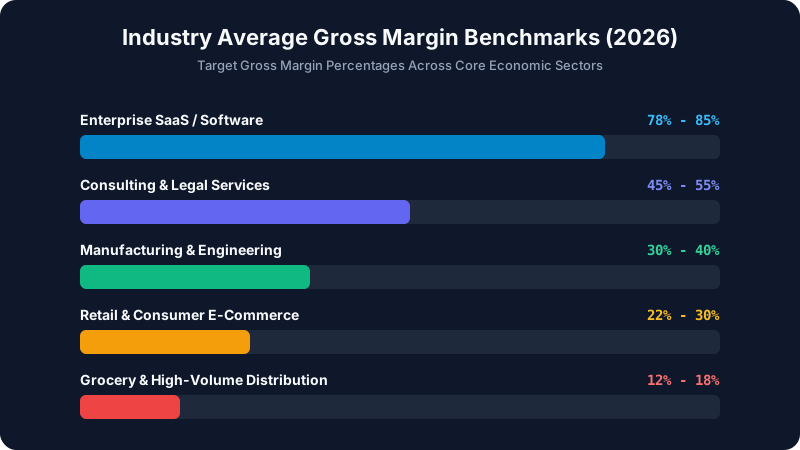
Sector Benchmark Comparison Table (2026 Standards)
Gross margin targets vary drastically by industrial sector due to asset intensity, inventory holding requirements, and human capital overhead:
| Industry Sector | Healthy Gross Margin (%) | Typical COGS Composition | Primary Margin Pressure |
|---|---|---|---|
| B2B Cloud Software | 75% – 85% | Cloud servers, CDNs, Tier-1 support | Data egress tariffs, AI token inference |
| Commercial Construction | 18% – 26% | Aggregates, framing, sub-trades | Commodity lumber & rebar volatility |
| Consumer Electronics | 32% – 48% | Semiconductors, tooling, lithium cells | Maritime shipping delays & yield scrap |
| Grocery & FMCG Retail | 20% – 28% | Wholesale inventory, cold storage | Perishable product spoilage & shrinkage |
| Specialty Medical Devices | 65% – 78% | Biocompatible polymers, cleanroom QA | Sterilization testing & lot audits |
Strategic Financial Traps: Why High Gross Margins Can Fail
A stellar gross margin is necessary, but wholly insufficient, for commercial survival. Businesses frequently collapse despite 70% gross margins due to runaway Sales & Marketing (CAC payback exceeding 24 months) or bloated General & Administrative payroll. Furthermore, discounting list prices during promotional campaigns compresses margins exponentially: discounting a product with a 30% gross margin by just 10% requires a 50% increase in unit sales volume merely to retain the exact same dollar gross profit.