The Standard Auto Loan Amortization Formula
The vast majority of modern auto loans utilize declining-balance simple interest amortization. Because interest accrues daily on the remaining principal balance, your monthly payment remains fixed while the internal allocation shifts from interest to principal over time:
// Fixed Monthly Payment Equation (PMT)
PMT = P × [ r(1 + r)ⁿ ] / [ (1 + r)ⁿ - 1 ]
P = Principal amount financed (Vehicle price - Down payment - Trade equity + Fees/Taxes)
r = Periodic monthly interest rate (Annual Percentage Rate ÷ 12 ÷ 100)
n = Total number of scheduled monthly payments (e.g. 60 months)
To find the total lifetime finance charge, multiply your calculated monthly payment by total months (PMT × n) and subtract the original principal financed (P). The difference represents the pure profit pocketed by the lending institution.
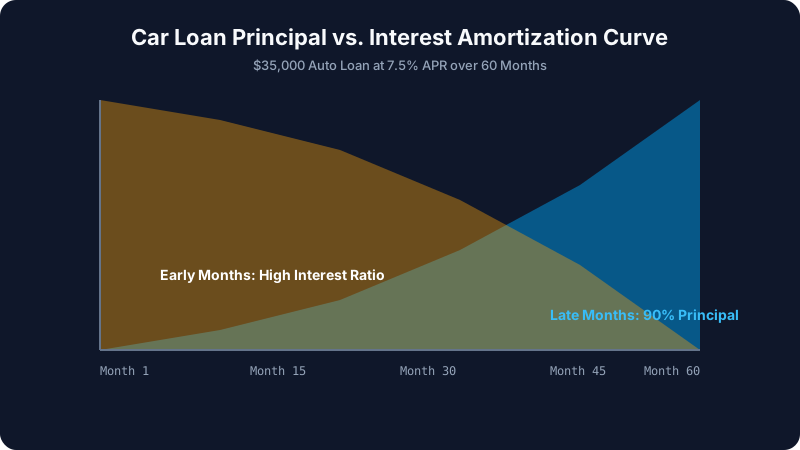
Simple Daily Interest vs. The Precomputed Rule of 78s
Before signing an auto purchase contract, verify the interest calculation method specified in the Federal Truth in Lending Act (TILA) disclosure box:
1. Simple Daily Interest (Industry Standard)
Each day, interest accrues according to: Daily Interest = (Principal Balance × APR) / 365. When your monthly payment arrives, it first covers the interest accrued over the preceding 30 days; the entire remainder reduces the principal balance. Making bi-weekly payments or adding $100 extra per month directly reduces the principal, eliminating future interest accrual.
2. Precomputed Interest (Rule of 78s / Flat Rate)
In precomputed contracts, total finance charges are calculated upfront and added to the principal immediately. If you attempt early payoff at month 24 of a 60-month loan, the lender utilizes an outdated mathematical formula (the Rule of 78s) heavily weighted toward early months, penalizing the borrower and denying a pro-rata interest rebate. While banned under US Federal Law (42 U.S.C. § 1615) for loans exceeding 61 months, it remains an aggressive trap in short-term subprime auto financing.
Calculate Your True Auto Payment with BentoQuilt
Calculate exact monthly payments, full amortization schedules, trade-in equity, and sales tax across all 50 US states.
Understanding APR vs. Advertised Base Interest Rate
Dealership advertisements frequently boast low interest rates (e.g. 3.9%), but the legally binding metric is the Annual Percentage Rate (APR). The APR incorporates not only the nominal borrowing rate, but also upfront financing origination fees, document preparation fees, gap insurance roll-ins, and mandatory administrative charges. The APR reflects the true annualized borrowing cost.
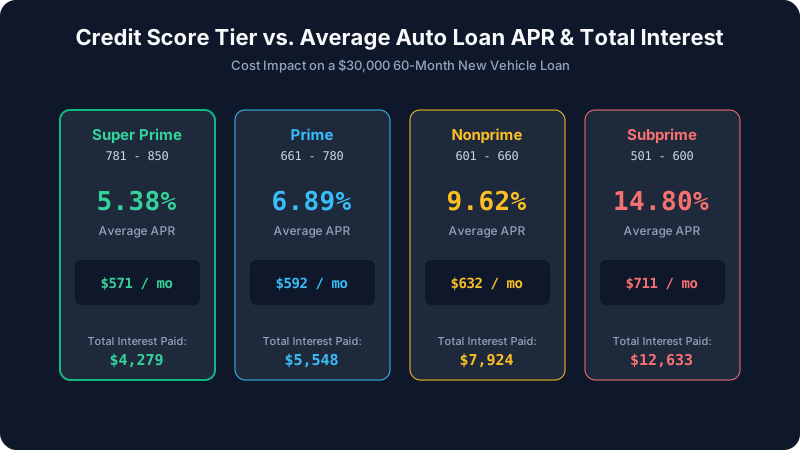
Worked Numerical Case Studies: 48-Month vs. 84-Month Comparison
Case Study 1: Financing $32,000 at 7.5% APR (48 Months vs 84 Months)
A consumer finances a $32,000 midsize SUV. The annual interest rate is 7.50% (monthly rate r = 0.075 / 12 = 0.00625):
Option A: 48-Month Term (4 Years)
PMT = 32,000 × [0.00625(1.00625)⁴⁸] / [(1.00625)⁴⁸ - 1] = $773.74 / month
Total Payments = $773.74 × 48 = $37,139.52
Total Interest Paid = $5,139.52
Option B: 84-Month Term (7 Years)
PMT = 32,000 × [0.00625(1.00625)⁸⁴] / [(1.00625)⁸⁴ - 1] = $490.87 / month
Total Payments = $490.87 × 84 = $41,233.08
Total Interest Paid = $9,233.08 (+$4,093.56 in wasted interest!)
The Verdict: Choosing the 84-month loan saves $282.87 per month on cash flow, but forces the buyer to pay $4,093.56 in additional interest. Worse, because new vehicles depreciate 20% in Year 1 and 15% in Years 2–4, an 84-month loan keeps the owner trapped in negative equity ('underwater') for the first four years.
Loan Term vs. Interest Cost Amortization Matrix
| Loan Term | Monthly Payment | Total Repayment | Lifetime Interest | Break-Even Equity Point |
|---|---|---|---|---|
| 36 Months (3 Yrs) | $995.42 | $35,835.12 | $3,835.12 | Month 14 (Positive Equity) |
| 48 Months (4 Yrs) | $773.74 | $37,139.52 | $5,139.52 | Month 22 (Positive Equity) |
| 60 Months (5 Yrs) | $641.13 | $38,467.80 | $6,467.80 | Month 36 (Positive Equity) |
| 72 Months (6 Yrs) | $553.11 | $39,823.92 | $7,823.92 | Month 48 (Underwater Risk) |
| 84 Months (7 Yrs) | $490.87 | $41,233.08 | $9,233.08 | Month 56 (Severe Negative Equity) |
Four Dealership Finance Office Traps to Avoid
When entering the dealership finance and insurance (F&I) office, consumers encounter four routine tactics designed to maximize lender yield:
- Dealer Markup on APR: Lenders frequently approve borrowers for 5.5% buy rates, but allow dealerships to quote 7.5% to the customer, pocketing the 2% spread as a dealer reserve bonus. Always obtain a pre-approved auto loan from a local credit union before entering a showroom.
- Payment Packing: F&I managers quote monthly payments that quietly bundle expensive add-ons ($1,200 tire-and-wheel protection, $900 window tinting, $2,500 extended warranty) into your loan balance.
- Yo-Yo Financing / Spot Delivery: Taking the vehicle home before financing is finalized, only to be called back days later with the claim that your loan fell through and you must accept a higher interest rate.
- GAP Insurance Rollover: Rolling unpaid negative equity from your previous car into your new vehicle loan, compounding interest on an asset you no longer possess.