The Four Mandatory Heads of Damage in Canadian Tort Law
Canadian civil courts evaluate personal injury claims by categorizing losses into four distinct, non-overlapping 'heads of damage':
// Fundamental Canadian Settlement Equation
Total Settlement = Non-Pecuniary (Pain & Suffering) + Past Out-of-Pocket + Future Income Loss + Future Care
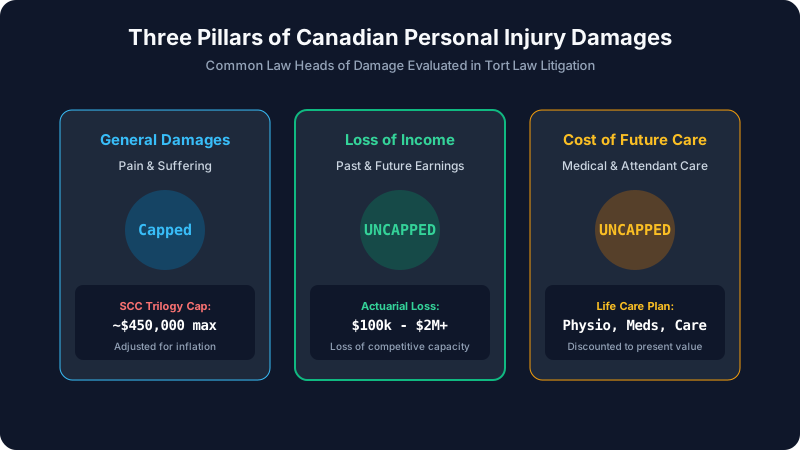
1. Non-Pecuniary: Capped at ~$450,000 for catastrophic quadriplegia/brain trauma.
2. Pecuniary Losses: 100% uncapped, calculated via actuarial economic models.
The crucial distinction in Canadian law is between pecuniary damages (financial losses that can be proven with invoices, actuarial math, and paystubs) and non-pecuniary damages (compensation for subjective pain, suffering, emotional distress, and loss of enjoyment of life).
The Supreme Court 'Trilogy' and the Non-Pecuniary Pain & Suffering Cap
In 1978, the Supreme Court of Canada rendered a landmark consolidated judgment across three concurrent appeals—Andrews v. Grand & Toy Alberta Ltd., Thornton v. School District No. 57, and Teno v. Arnold (collectively known as the Trilogy). The Court ruled that runaway jury awards for pain and suffering threatened to destabilize social insurance, imposing a strict constitutional ceiling of $100,000 for the most catastrophic injuries conceivable.
However, the Court mandated that this $100,000 ceiling must be adjusted annually for Canadian CPI inflation. In 2026, the trilogy cap sits at approximately $440,000 to $455,000. This figure represents the absolute legal maximum awarded for the most devastating injuries (such as high-level cervical spinal quadriplegia or permanent vegetative coma). A soft-tissue whiplash injury or fractured ankle will typically yield between $25,000 and $65,000 under Canadian case-law tariffs.
Calculate Canadian Settlements with BentoQuilt
Calculate pain and suffering damages, actuarial future care present value, and legal contingency fees under Canadian law.
Loss of Earning Capacity & Future Care: Actuarial Discount Rates
While pain and suffering is capped, pecuniary damages are completely uncapped and routinely constitute 80% to 90% of seven-figure Canadian settlement packages:
1. Future Loss of Earning Capacity
Calculates the difference between the plaintiff's pre-injury career earning trajectory and their impaired residual earning capacity through normal retirement age (65). Forensic economists account for promotional progression, pension contributions, and statistical labor force contingencies (e.g. sickness, economic recession, parental leave).
2. Cost of Future Care
Occupational therapists prepare a formal Life Care Plan detailing every future medical requirement: specialized wheelchair-accessible housing modifications, attendant care nurses, private physiotherapy, prescription analgesics, and vehicle hand-controls.
3. The Statutory Present Value Discount Rate
Because the plaintiff receives a lump sum today to cover expenses 20 or 30 years into the future, the capital can be invested in government bonds. Provincial Rules of Civil Procedure mandate statutory real discount rates (e.g. 2.5% in Ontario) to discount future annual sums into present-day capital dollars.
Worked Settlement Case Studies: Commercial Driver vs. Pedestrian
Case Study 1: Moderate Spinal Disc Herniation (38-Year-Old Heavy Duty Mechanic)
A mechanic earning $85,000/year suffers two herniated lumbar discs in a rear-end collision in Calgary, leaving him permanently restricted to light sedentary retail parts desk work ($45,000/year):
Non-Pecuniary General Damages (Pain & Suffering): $110,000
Past Loss of Income (2 years pre-trial): 2 × $85,000 = $170,000
Future Earning Loss ($40,000 deficit/yr for 25 yrs to age 65 @ 2.5% discount): $728,000
Future Care Costs (Physiotherapy, massage, ergonomic equipment): $45,000
Out-of-Pocket Special Damages (Prescriptions, braces): $6,800
Gross Settlement Value: $1,059,800
Legal Contingency Fee (30% + 5% GST): -$333,837
Net Payout to Injured Plaintiff = $725,963
Case Study 2: Pedestrian Traumatic Brain Injury (Catastrophic Impairment)
A university student is struck in an intersection, sustaining severe cognitive deficits. The settlement reaches $3.8 Million, comprising: Maximum Trilogy Cap ($450,000) + Complete Lifetime Loss of Professional Earning Capacity ($1,850,000) + 24/7 Attendant Nursing Care & Specialized Residence ($1,400,000) + Subrogated Provincial Health Healthcare Costs ($100,000).
Provincial Tort vs. No-Fault Systems: The Regional Divide
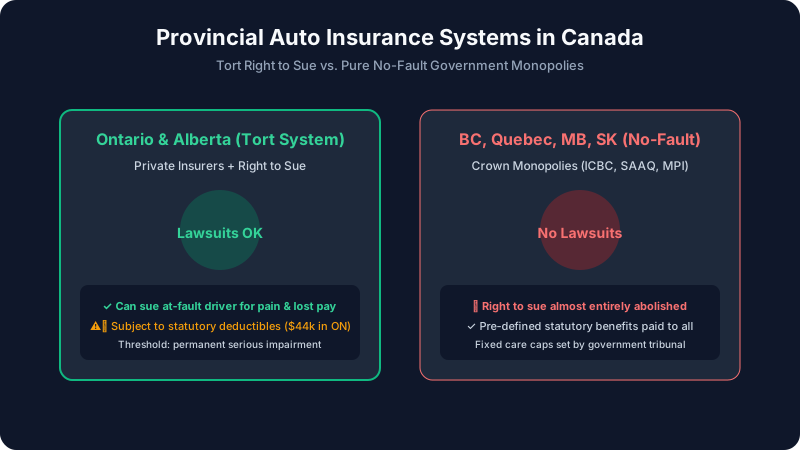
How personal injury claims are processed depends fundamentally on which province the collision occurred in:
| Province | Insurance System | Right to Sue in Tort? | Statutory Deductibles / Soft-Tissue Caps |
|---|---|---|---|
| Ontario | Hybrid No-Fault / Tort | Yes (If Threshold Met) | Statutory ~$44,000 deductible on general damages under $147,000 |
| British Columbia (ICBC) | Enhanced Pure No-Fault | Virtually Eliminated | Lawsuits banned for post-May 2021 accidents; ICBC fixed benefits only |
| Alberta | Tort System with Minor Injury Cap | Yes | Minor Injury Regulation (MIR) caps soft-tissue sprains (~$6,000) |
| Quebec (SAAQ) | Pure Public No-Fault | Prohibited | Automobile Insurance Act bars all civil litigation against drivers |
Provincial Healthcare Subrogation & Legal Contingency Fees
In Canada, taxpayers do not pay out-of-pocket for acute hospital surgery or physician visits under provincial healthcare (such as OHIP in Ontario, MSP in BC, or AHCIP in Alberta). However, under provincial Health Insurance Acts, the provincial government maintains a statutory right of subrogation. When your lawyer settles your lawsuit, the provincial Ministry of Health submits a subrogated claim (often $15,000 to $80,000) for hospital care, emergency trauma surgery, and diagnostic MRIs. This sum must be paid directly to the government out of the settlement proceeds before funds are disbursed to the injured victim.