The Three-Component Cost Architecture of a Single Dental Implant
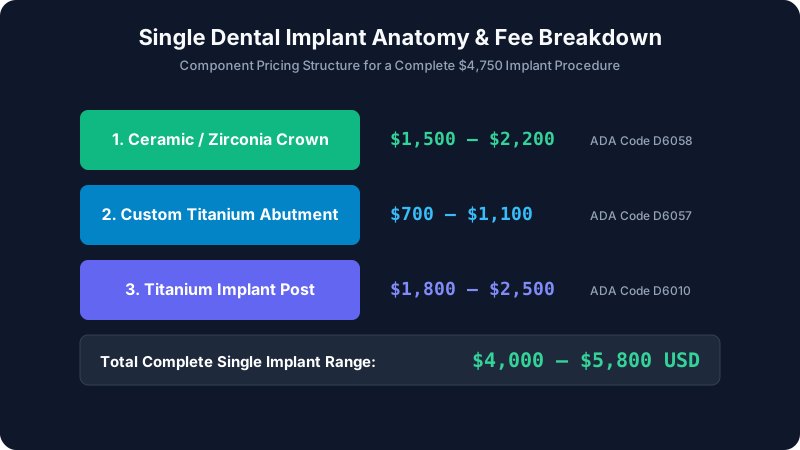
When consumers see advertised promotions for '$999 Dental Implants', they are invariably reading a bait-and-switch quotation that covers only the surgical screw fixture. A functional dental implant consists of three separate medical devices, each billed with its own American Dental Association (ADA) CDT procedure code:
1. The Implant Fixture Post (CDT Code D6010)
$1,500 – $2,500The threaded medical-grade Grade 4 or 5 titanium or zirconia cylinder surgically inserted into the mandibular or maxillary alveolar bone. Its porous micro-textured surface promotes osseointegration—the direct structural fusion of living bone cells with the titanium oxide surface over 3 to 6 months.
2. The Transmucosal Abutment (CDT Code D6056 / D6057)
$400 – $1,000The connector post fastened into the internal screw chamber of the titanium fixture that emerges through the gum tissue (gingiva). Custom CAD/CAM milled titanium or zirconia abutments are precision-engineered to replicate natural tooth emergence profiles, preventing peri-implant food impaction.
3. The Prosthetic Crown (CDT Code D6058 / D6065)
$1,200 – $2,000The visible aesthetic artificial tooth, typically crafted from monolithic translucent zirconia or layered lithium disilicate (E.max) ceramic to resist 150+ psi mastication forces and match adjacent tooth shade profiles.
// Total Single Tooth Replacement Cost
Total Turnkey Cost = Post ($2,000) + Abutment ($600) + Crown ($1,500) = $4,100 Average
Preparatory Surgical Procedures: Bone Grafts, Sinus Lifts, and Extractions
When a tooth is extracted or lost, the alveolar bone naturally resorbs by 40% to 60% in width and height within the first 12 to 24 months. If insufficient bone volume exists to house a standard 3.5mm to 5.0mm diameter implant, secondary regenerative surgeries are required:
- Atraumatic Extraction with Socket Preservation (D7953): $300 to $650 per tooth. Particulate freeze-dried bone allograft (human donor) or xenograft (bovine) is packed into the fresh extraction socket beneath a collagen membrane to prevent alveolar ridge collapse.
- Alveolar Ridge Augmentation (D7951): $800 to $2,500. Required when the jawbone is already collapsed, expanding the bone ridge width prior to fixture placement.
- Direct Lateral Window Sinus Lift: $1,500 to $3,500 per quadrant. In the upper posterior jaw (molars), the maxillary sinus cavity naturally drops (pneumatizes). A lateral window is opened to gently elevate the Schneiderian sinus membrane and pack bone graft beneath, providing 10mm+ vertical bone anchor depth.
- IV Moderate Sedation / General Anesthesia: $600 to $1,500 per hour. Highly recommended for full-arch surgery and complex bone reconstruction.
Calculate Total Dental Implant Costs Online
Calculate single, multiple, and full-arch All-on-4 dental implant surgical estimates including sedation and grafting fees.
Full-Arch Rehabilitation: All-on-4 vs. All-on-6 Systems
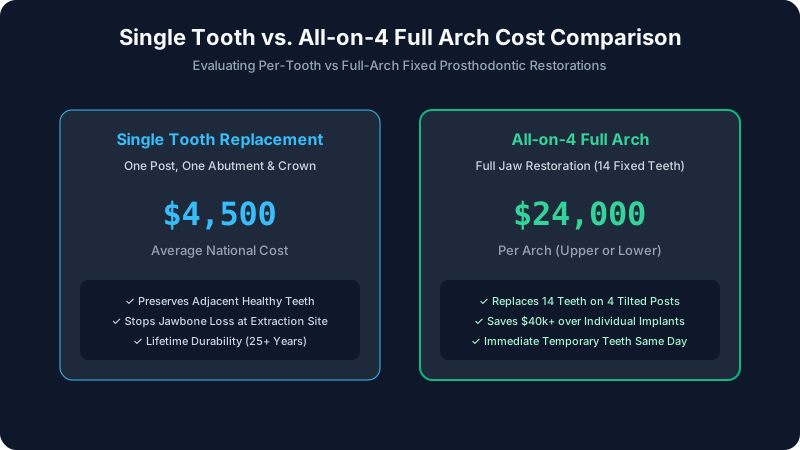
For patients suffering from total edentulism (complete tooth loss) or severe generalized periodontal disease, placing an individual implant per tooth (14 implants per arch) is clinically unnecessary and financially impossible. The All-on-4 protocol utilizes four strategically positioned titanium implants—with the two posterior fixtures tilted at 30 to 45 degrees to bypass the mental nerve or maxillary sinus—to anchor a rigid, non-removable prosthetic bridge:
Standard All-on-4 ($18,000 – $26,000 / arch)
Features a computer-milled titanium substructure wrapped in high-impact pink acrylic denture resin with composite teeth. Lightweight and shock-absorbing, but acrylic teeth experience wear over 7 to 10 years and require periodic polishing or tooth re-setting.
Premium All-on-6 ($28,000 – $38,000 / arch)
Utilizes six implants to maximize biting load distribution, supporting an unbreakable single-piece zirconia arch bridge. Zirconia is 100% non-porous, will never chip, stain, or absorb oral odors, offering lifetime durability for high-force bruxism patients.
Comprehensive Dental Implant Pricing & CDT Fee Matrix
| Procedure Description | ADA CDT Code | National Average Cost | Typical Insurance Coverage |
|---|---|---|---|
| Surgical Implant Body (Endosteal) | D6010 | $1,850 – $2,600 | 0% – 50% (Subject to $1.5k cap) |
| Prefabricated / Custom Abutment | D6056 / D6057 | $450 – $950 | 50% Major Services |
| Implant-Supported Porcelain/Zirconia Crown | D6058 / D6065 | $1,350 – $2,100 | 50% Major Services |
| Socket Bone Grafting (At Extraction) | D7953 | $350 – $750 | Rarely covered (Deemed elective) |
| Direct Lateral Sinus Augmentation | D7951 | $1,800 – $3,200 | May qualify for Major Medical |
| Full-Arch Fixed Acrylic Bridge (All-on-4) | D6075 / D6114 | $18,000 – $28,000 / arch | Limited to alternative denture benefit |
Insurance Maximization, Healthcare FSAs & Tax Deductibility
Navigating the financial architecture of dental implant surgery requires deploying strategic payment vehicles:
- Cross-Year Benefit Splitting: Because standard dental insurance caps annual payouts at $1,000 to $2,000 per calendar year, timing is vital. Schedule tooth extraction and surgical bone grafting in November or December (using Year 1 benefits), followed by implant body placement and crown restoration in January or February (tapping fresh Year 2 benefits).
- Health Savings Accounts (HSA) & Flexible Spending Accounts (FSA): Dental implant surgery is a 100% qualified medical expense under IRS Publication 502. Paying with pre-tax HSA/FSA dollars saves 25% to 37% depending on your federal and state tax bracket.
- IRS Medical Expense Deduction: If your total unreimbursed medical and dental expenses exceed 7.5% of your Adjusted Gross Income (AGI), all expenditures beyond that threshold can be deducted on Schedule A (Itemized Deductions) of your federal tax return.