Step 1: Converting Clock Times and Decimalizing Minutes
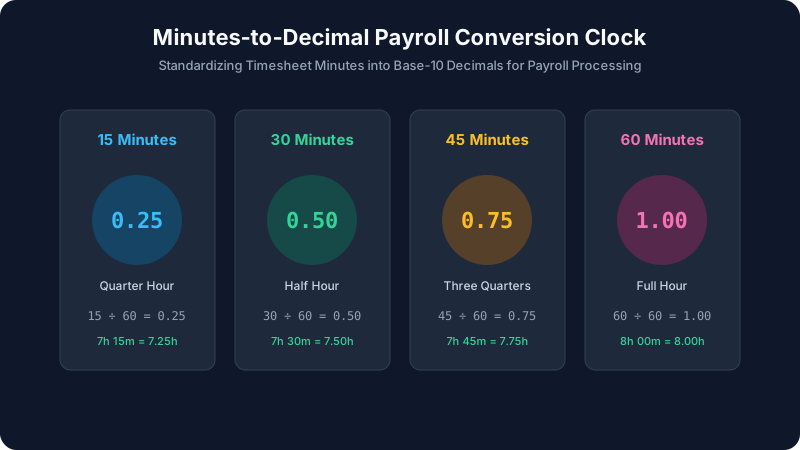
The foundational error in payroll arithmetic is treating clock minutes as decimal fractions. A worker clocking 8 hours and 30 minutes does not work 8.30 hours—they work 8.50 hours (30 / 60 = 0.50). Multiplying 8.30 by a $20.00 hourly rate cheats the employee out of $4.00 per shift:
// Minute-to-Decimal Conversion Equation
Decimal Hours = Total Hours + (Total Minutes / 60)
// 7-Minute Payroll Rounding Rule (FLSA 29 CFR § 785.48(b))
1 to 7 min = Round to 0.00 | 8 to 14 min = Round to 0.25 (15 min)
Federal law permits employers to round clock times to the nearest quarter-hour (15-minute increment), but only if the rounding operates neutrally or in the employee's favor. If an employer rounds clock-ins forward (8:02 AM becomes 8:15 AM) but also rounds clock-outs backward (5:07 PM becomes 5:00 PM), it constitutes unlawful wage theft.
Federal FLSA (Weekly) vs. California Daily Overtime Mandates
1. The US Federal Standard (FLSA 29 U.S.C. § 207)
Under the Fair Labor Standards Act (FLSA), overtime is evaluated strictly on a workweek basis. A non-exempt employee who works 12 hours on Monday, 12 hours on Tuesday, and takes the remaining 5 days off works 24 total weekly hours. Under federal law, they are entitled to zero overtime pay because total weekly hours did not exceed 40.
2. The California Daily Overtime Standard (Labor Code § 510)
California enforces the most worker-protective daily thresholds in the United States:
- 1.5× Regular Rate (Time-and-a-Half): All hours worked beyond 8 hours up to 12 hours in any single workday, and for the first 8 hours worked on the 7th consecutive day of work.
- 2.0× Regular Rate (Double-Time): All hours worked beyond 12 hours in any single workday, and for all hours worked beyond 8 hours on the 7th consecutive day of work.
Calculate Penalty Rates & Overtime with BentoQuilt
Calculate Australian Modern Award penalty rates, weekend shifts, public holiday multipliers, and US overtime instantly.
Calculating the True 'Regular Rate of Pay' (Non-Discretionary Bonuses)
Overtime is not simply 1.5 times the base base hourly wage if the worker receives nondiscretionary performance bonuses, shift differentials, or commissions:
Regular Rate = (Total Base Pay + Non-Discretionary Bonuses + Shift Differentials) / Total Hours Worked
Overtime Premium = Regular Rate × 1.5
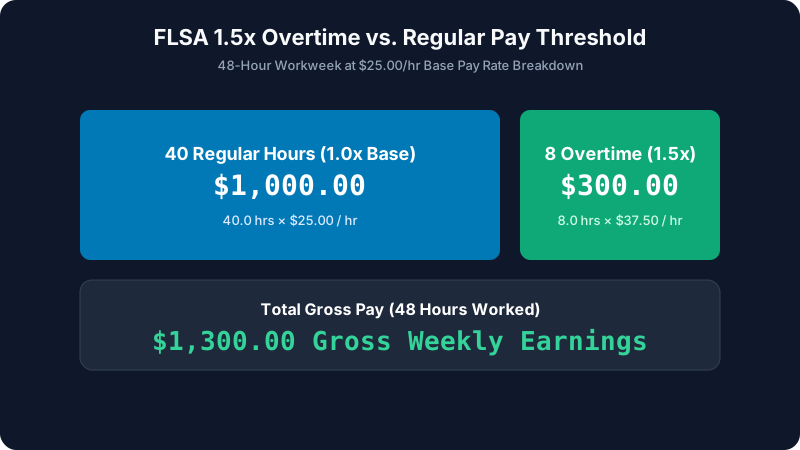
If an employee earning $25.00/hr works 50 hours and earns a $200.00 attendance bonus, total straight-time earnings equal (50 × $25) + $200 = $1,450. Their true Regular Rate is $1,450 / 50 = $29.00/hr. Their 10 overtime hours must be compensated at $29.00 × 1.5 = $43.50/hr, not 1.5 × $25 = $37.50/hr.
Worked Payroll Case Studies: Manufacturing & Healthcare
Case Study 1: Warehouse Logistics Specialist (Federal FLSA)
A forklift operator earns $22.00/hr with no bonuses. During a holiday rush, their time card logs 47.50 hours:
Regular Hours (First 40): 40.00 × $22.00 = $880.00
Overtime Multiplier: $22.00 × 1.5 = $33.00/hr
Overtime Hours: 7.50 × $33.00 = $247.50
Gross Weekly Pay = $880.00 + $247.50 = $1,127.50
Case Study 2: California Travel Nurse (Daily Overtime & Double-Time)
A nurse in Los Angeles earning $45.00/hr works a grueling 14-hour emergency room trauma shift. Under California Labor Code 510:
Straight Time (First 8 Hours): 8.00 × $45.00 = $360.00
Overtime Time-and-a-Half (Hours 8 to 12): 4.00 × ($45 × 1.5) = 4.00 × $67.50 = $270.00
Double-Time (Hours 12 to 14): 2.00 × ($45 × 2.0) = 2.00 × $90.00 = $180.00
Total 14-Hour Shift Gross Earnings = $360.00 + $270.00 + $180.00 = $810.00
(Average effective hourly rate achieved: $57.86/hr)
Minutes-to-Decimals Payroll Quick Reference Table
| Clock Minutes | Exact Decimal Fraction | Quarter-Hour Rounding | Tenth-Hour (6-Min) System |
|---|---|---|---|
| 1 to 5 Minutes | 0.02 – 0.08 | 0.00 | 0.00 – 0.10 |
| 15 Minutes | 0.250 | 0.25 | 0.20 – 0.30 |
| 30 Minutes | 0.500 | 0.50 | 0.50 |
| 45 Minutes | 0.750 | 0.75 | 0.70 – 0.80 |
| 50 Minutes | 0.833 | 0.75 or 1.00 | 0.80 |
Meal & Rest Break Traps: When Deductions Become Unlawful
Automatic 30-minute payroll deductions for lunch breaks are illegal if the employee remains 'on-call' or performs incidental work during that period. Under 29 CFR § 785.19, an unpaid meal break requires the employee to be completely relieved from duty; if a receptionist answers a single phone call while eating a sandwich at their desk, the entire 30 minutes must be paid as compensable working time. In states like California, failing to provide a timely 30-minute meal break mandates paying a one-hour premium penalty at the worker's regular rate of pay.