The Statutory Mandate: AS/NZS 3000 Wiring Rules Overview
Clause 2.2.2 of AS/NZS 3000:2018 mandates that the maximum demand of an electrical installation must be determined using one of four authorized engineering methodologies: Calculation (Appendix C), Assessment, Measurement, or Limitation. For residential domestic and commercial premises, Calculation by Appendix C Table C1 is the universally accepted standard enforced by electrical safety regulators (such as Energy Safe Victoria, SafeWork NSW, and Queensland Electrical Safety Office).
// Fundamental Single-Phase Current Equation
Current I (Amps) = Power P (Watts) / [Voltage V (230V) × Power Factor (cos φ)]
// Three-Phase Line Current Equation
Line Current I_L = Power P (Watts) / [√3 × Line Voltage V_L (400V) × cos φ]
Diversity recognizes that every light fixture, toaster, vacuum cleaner, and air conditioning unit in a dwelling will never operate simultaneously at full rated capacity. Calculating without diversity would require massive, cost-prohibitive 150A copper consumer mains for standard four-bedroom suburban residences.
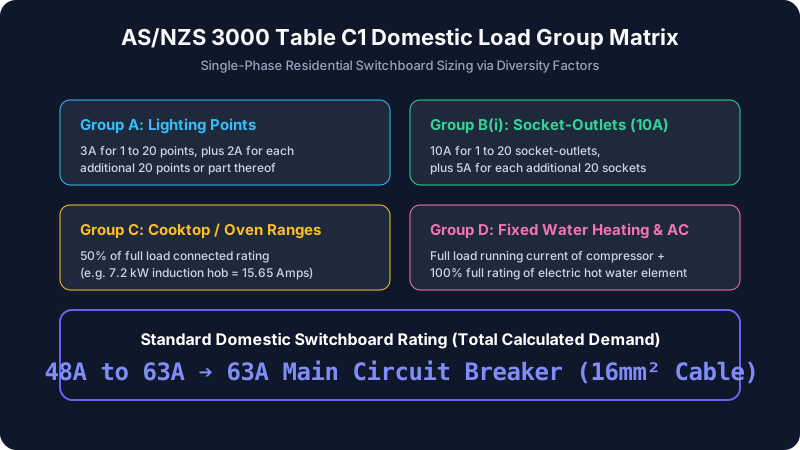
Deconstructing AS/NZS 3000 Table C1 (Domestic Installations)
Table C1 divides domestic residential loads into discrete functional categories with specific statutory current allocations:
Group A: Lighting Points
- 3 Amps for 1 to 20 lighting points.
- Add 2 Amps for each additional 20 points (or part thereof).
- Example: A home with 55 LED downlights = 3A (first 20) + 2A (next 20) + 2A (final 15) = 7 Amps.
Group B(i): 10A General Purpose Socket-Outlets (GPOs)
- 10 Amps for 1 to 20 points.
- Add 5 Amps for each additional 20 points (or part thereof).
- Example: A home with 44 single/double power points = 10A (first 20) + 5A (next 20) + 5A (next 4) = 20 Amps.
Group C: Cooking Appliances (Ranges, Ovens, Cooktops)
- Single appliance: 50% of full connected load rating.
- Multiple cooking appliances: 50% of the largest appliance + 33% of remaining appliances.
Group D: Fixed Space Heating & Air Conditioning (HVAC)
- 75% of full load current of the largest heating or cooling unit, plus 50% of remaining units. If interlocked against simultaneous operation, assess only the largest heating or cooling mode.
Group F: Electric Storage Water Heaters
- Full load rated current of the heating element (typically 15A for a standard 3.6 kW continuous immersion element).
Size Cables to AS/NZS 3008 with BentoQuilt
Calculate cable ampacity, voltage drop, and fault ratings according to Australian Standard AS/NZS 3008 after computing your maximum demand.
Single-Phase vs. Three-Phase Supply Balancing
When calculated maximum demand exceeds the standard DNSP (Distribution Network Service Provider, such as Ausgrid, Energex, or Powercor) single-phase service fuse limit—typically 63A or 80A—the installation must be converted to a 400V Three-Phase supply.
In a three-phase calculation, load groups are assigned across Phase A, Phase B, and Phase C. The maximum demand of the entire installation is governed by the heaviest loaded single phase. For example, if Phase A totals 42A, Phase B totals 38A, and Phase C totals 51A, the incoming service mains and main circuit breakers must be rated for at least 51A per phase (standard 63A three-phase main breaker).
Worked Engineering Case Study: Melbourne Suburban Residence
4-Bedroom Home Specification (Single-Phase 230V)
An electrician audits a new four-bedroom home with 48 downlights, 35 double GPOs, a 7.2 kW induction cooktop, a 3.6 kW hot water cylinder, a 5.0 kW reverse cycle split air-conditioner, and a 32A Level 2 EV charging station:
Group A (48 Lights): 3A + 2A + 2A = 7.00 Amps
Group B (35 GPOs): 10A + 5A = 15.00 Amps
Group C (7.2 kW Induction): 7200W / 230V = 31.3A @ 50% diversity = 15.65 Amps
Group D (5.0 kW Inverter A/C): 5000W / (230V × 0.85 PF) = 25.57A @ 75% diversity = 19.18 Amps
Group F (3.6 kW Hot Water): 3600W / 230V = 15.65 Amps (No diversity)
Electric Vehicle Supply Equipment (EVSE): 32.00 Amps (Mandatory 100% per AS/NZS 3000:2018 Cl 7.9)
Total Calculated Maximum Demand = 104.48 Amps
Engineering Decision: A 104.48A maximum demand far exceeds standard 63A or 80A single-phase network supply limits. The electrician must either install an intelligent EV dynamic load-management shedder or mandate a Three-Phase 400V 63A Supply Upgrade, balancing the EVSE on Phase A (32A), the cooktop and hot water on Phase B (31.3A), and the air conditioning, lighting, and general power on Phase C (41.18A).
AS/NZS 3000 Table C1 Domestic Reference Matrix
| Load Classification | Clause / Table Group | Statutory Diversity Rule (Domestic Dwelling) | Typical Demand Value |
|---|---|---|---|
| Lighting Points | Group A(i) | 3A for 1–20 pts + 2A per additional 20 pts | 5A – 9A |
| 10A Socket Outlets | Group B(i) | 10A for 1–20 pts + 5A per additional 20 pts | 15A – 25A |
| Electric Cooktop / Range | Group C | 50% of full rated connected load | 12A – 20A |
| Space Air Conditioning | Group D | 75% of largest unit + 50% remaining units | 15A – 30A |
| Storage Water Heater | Group F | 100% full rated element current (No diversity) | 15A – 20A |
| Electric Vehicle Charger | Appendix C / Cl 7.9 | 100% full rating unless automated load managed | 32A |
Connecting Maximum Demand to AS/NZS 3008 Cable Sizing
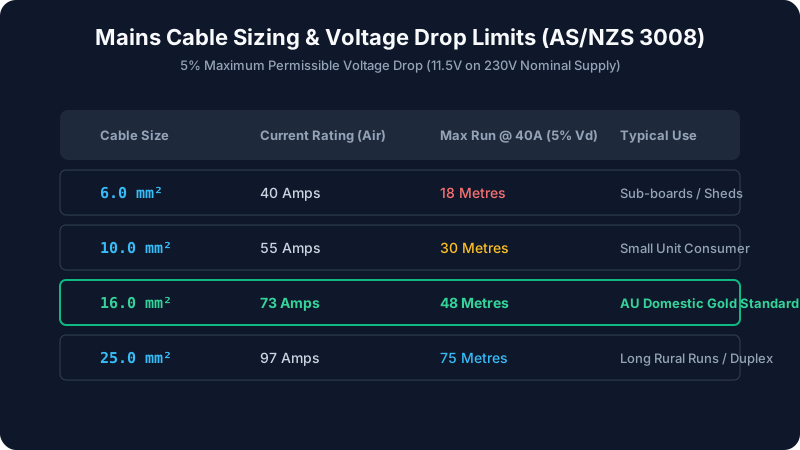
Once your Maximum Demand is determined, you must size the consumer mains conductors according to AS/NZS 3008.1.1:2017. Conductor cross-sectional area (mm²) must satisfy two independent tests: Current-Carrying Capacity (factoring ambient temperature derating and thermal insulation contact) and Voltage Drop. Under AS/NZS 3000 Clause 3.6.2, total voltage drop between the point of supply and any point of utilization must not exceed 5% of nominal voltage (11.5 Volts on a 230V single-phase system or 20 Volts on a 400V three-phase system).