The Fundamental Reaction Enthalpy Formula
The total enthalpy change of a gas-phase chemical reaction (ΔH) is evaluated using the law of conservation of energy by subtracting the energy released during bond formation from the energy required to break initial reactant bonds:
// Fundamental Reaction Enthalpy Equation
ΔH_rxn = Σ [ D(bonds broken) ] - Σ [ D(bonds formed) ]
D = Molar bond dissociation enthalpy in kiloJoules per mole (kJ/mol)
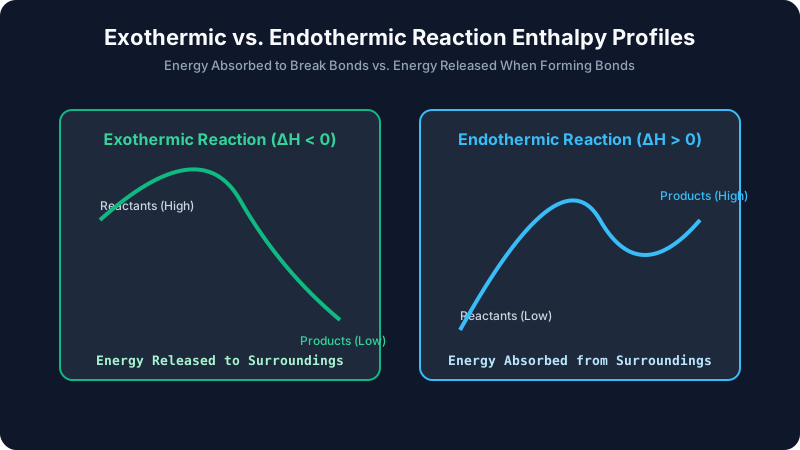
ΔH < 0 (Negative): Exothermic reaction (heat released, combustion, warmth)
ΔH > 0 (Positive): Endothermic reaction (heat absorbed, instant cold packs)
Note the critical thermodynamic sign convention: Breaking chemical bonds always requires an input of work and thermal kinetic energy (an endothermic process, assigned a positive sign +). Conversely, when atoms snap together into stable lower-energy covalent orbitals, excess potential energy is shed into the environment as heat (an exothermic process, assigned a negative sign -).
The Disciplined 4-Step Bond Calculation Protocol
- Balance the Chemical Equation: Thermodynamic stoichiometry is impossible without correct integer coefficients. Unbalanced equations produce fatal errors.
- Draw Complete Lewis Dot Structures: Never guess bond order from empirical formulas. Carbon dioxide (CO₂) contains two double bonds (O=C=O), not single bonds. Nitrogen gas (N₂) contains a massive triple bond (N≡N, 945 kJ/mol).
- Sum the Energy of Broken Bonds (Reactants): Multiply the stoichiometric coefficient by the number of each specific bond type present in reactant molecules. Sum all values.
- Sum the Energy of Formed Bonds (Products): Tally all newly created covalent bonds across product molecules. Subtract this sum from the reactant sum.
Calculate Molecular Thermodynamics with BentoQuilt
Calculate molecular enthalpy, bond dissociation totals, and reaction energy changes with our precision scientific engine.
Bond Multiplicity: Single, Double, and Triple Covalent Bonds
A double bond is neither simply 'twice' as strong as a single bond, nor is a triple bond three times as strong. In molecular orbital theory, a single bond consists of a strong axial sigma (σ) orbital overlap. Secondary and tertiary bonds consist of lateral pi (π) orbital overlaps, which have weaker spatial alignment:
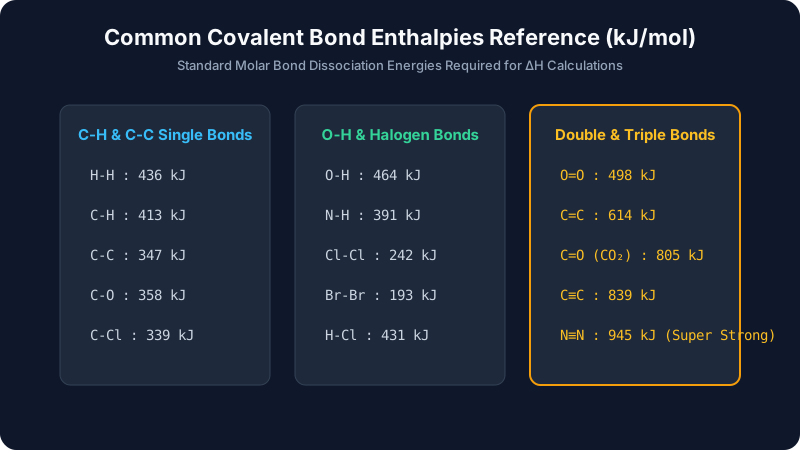
347 kJ/mol
Bond Length: 154 pm (1 σ bond)
614 kJ/mol
Bond Length: 134 pm (1 σ + 1 π)
839 kJ/mol
Bond Length: 120 pm (1 σ + 2 π)
Worked Chemical Thermodynamics Case Studies: Methane & Ammonia
Case Study 1: Combustion of Methane (Natural Gas)
Evaluate the enthalpy of combustion for methane gas: CH₄(g) + 2 O₂(g) → CO₂(g) + 2 H₂O(g)
1. Bonds Broken (Reactants):
• 4 × (C-H) bonds in CH₄ = 4 × 413 kJ/mol = 1,652 kJ
• 2 × (O=O) bonds in 2 O₂ = 2 × 498 kJ/mol = 996 kJ
Total Energy Absorbed to Break Bonds = 1,652 + 996 = +2,648 kJ
2. Bonds Formed (Products):
• 2 × (C=O) bonds in CO₂ = 2 × 804 kJ/mol = 1,608 kJ (special carbonyl value)
• 4 × (O-H) bonds in 2 H₂O = 4 × 464 kJ/mol = 1,856 kJ
Total Energy Released Forming Bonds = 1,608 + 1,856 = 3,464 kJ
3. Net Enthalpy Change (ΔH):
ΔH = 2,648 kJ - 3,464 kJ = -816 kJ/mol (Exothermic!)
Case Study 2: Industrial Haber-Bosch Ammonia Synthesis
Nitrogen and hydrogen combine to form ammonia: N₂(g) + 3 H₂(g) → 2 NH₃(g). Reactants break 1 (N≡N) triple bond (945 kJ) + 3 (H-H) bonds (3 × 436 = 1,308 kJ), totaling +2,253 kJ. Products form 6 (N-H) bonds in two NH₃ molecules (6 × 391 = 2,346 kJ). Net enthalpy: ΔH = 2,253 - 2,346 = -93 kJ/mol (Mildly exothermic equilibrium reaction).
Standard Average Bond Dissociation Enthalpies Reference Table (kJ/mol)
| Bond Type | Enthalpy (kJ/mol) | Bond Type | Enthalpy (kJ/mol) |
|---|---|---|---|
| H – H | 436 | C – C | 347 |
| C – H | 413 | C = C | 614 |
| O – H | 464 | C ≡ C | 839 |
| N – H | 391 | C = O (CO₂) | 804 |
| O = O | 498 | N ≡ N | 945 |
| Cl – Cl | 243 | H – Cl | 432 |
Accuracy Limitations: Bond Enthalpies vs. Hess's Law
Calculations using bond energies provide an excellent estimate (typically within 5% to 10% of experimental reality), but they are not exact. Published bond energies represent statistical averages measured across hundreds of diverse molecular environments. For example, the C-H bond in methane (CH₄) requires slightly different energy to break than the C-H bond in formaldehyde (H₂CO). For rigorous precision engineering in chemical manufacturing, engineers utilize Hess's Law and Standard Enthalpies of Formation (ΔH°f), which measure exact compound heats of formation from reference elements.