The Mathematical Salt Dosage Equations (Imperial & Metric)
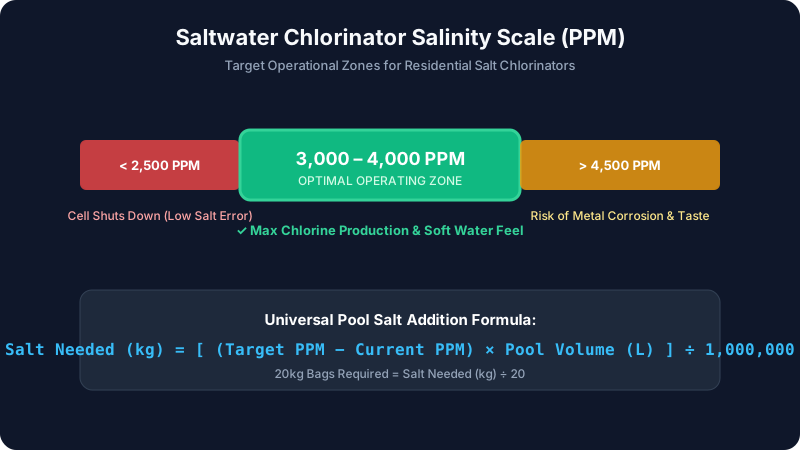
Calculating the exact quantity of salt required involves finding the mathematical difference between your Target Salinity (PPM) and your Current Tested Salinity (PPM), scaled by total pool water volume:
// Imperial Equation (Pounds of Salt)
Salt (lbs) = [Pool Gallons × (Target PPM - Current PPM) × 8.35] / 1,000,000
// Metric Equation (Kilograms of Salt)
Salt (kg) = [Pool Liters × (Target PPM - Current PPM)] / 1,000,000
// Standard Bag Counts
40 lb Bags = Salt (lbs) / 40 | 20 kg Bags = Salt (kg) / 20
Never rely on factory default dashboard estimates on your chlorinator control box to determine your current PPM. Chlorinator salt sensors scale with water temperature; cold water (below 15°C / 60°F) falsely reports low salt even when chemical levels are perfectly balanced.
Calculating Exact Pool Water Volume
Accurate dosing begins with knowing your pool's actual water volume. To calculate average depth in a sloping pool, add the shallow end depth to the deep end depth and divide by 2:
1. Rectangular Pools
- Gallons: Length (ft) × Width (ft) × Average Depth (ft) × 7.4805
- Liters: Length (m) × Width (m) × Average Depth (m) × 1,000
2. Circular / Round Above-Ground Pools
- Gallons: 3.1416 × [Radius (ft)]² × Average Depth (ft) × 7.4805
- Liters: 3.1416 × [Radius (m)]² × Average Depth (m) × 1,000
3. Kidney & Freeform Shapes
Multiply the longest length by the average of the two distinct widths, then multiply by average depth and an architectural reduction factor of 7.0 (rather than 7.48) to compensate for curved perimeter contours.
Calculate Exact Pool Salt Bags Online
Input current PPM, target PPM, and pool dimensions to calculate exact 20kg or 40lb bags of salt required with our precision tool.
Step-by-Step Salt Addition Protocol: Preventing Cell Damage
Dumping salt directly into the skimmer or adding salt with the salt cell active is a catastrophic error that voids equipment warranties. Follow this licensed technician protocol:
- Test Current Water Salinity: Use an electronic optical handheld refractometer or silver nitrate titration drop test kit. Note your starting baseline (e.g., 800 PPM).
- Turn OFF the Chlorinator Cell: Switch the electrolytic cell power supply completely off or set output to 0%. Keep the main circulation filter pump running 24/7.
- Broadside Distribution: Slice the bags open and broadcast the granular salt around the shallow end perimeter and along the outer coping perimeter.
- Manual Agitation: Brush the pool floor vigorously with a nylon pool wall brush until no undispersed salt mounds remain. Undissolved salt resting on vinyl liners can bleach patterns, and on gunite plaster can cause manganese and mineral staining.
- 24-Hour Full Dissolution: Allow the main pump to circulate the water continuously for 24 hours. Retest salinity with your independent kit. Once salinity is verified between 3,200 and 3,400 PPM, turn the chlorinator cell back on.
Worked Dosing Case Studies: Spring Opening & Mid-Season Top Up
Case Study 1: Spring Pool Opening (18,000 Gallon Inground Pool)
A homeowner in Texas reopens an 18,000-gallon pool. Winter rainwater dilution lowered salinity to 1,100 PPM. The Hayward AquaRite system requires an optimal level of 3,200 PPM (a deficit of 2,100 PPM):
Pool Volume: 18,000 Gallons
Deficit: 3,200 PPM - 1,100 PPM = 2,100 PPM
Salt Required (lbs) = [18,000 × 2,100 × 8.35] / 1,000,000 = 315.63 lbs
40 lb Bags: 315.63 / 40 = 7.89 Bags
Recommendation: Add exactly 7 bags (280 lbs) immediately; test after 24 hours before adding the 8th bag.
Case Study 2: Australian Fibreglass Pool Mid-Summer Top-Up
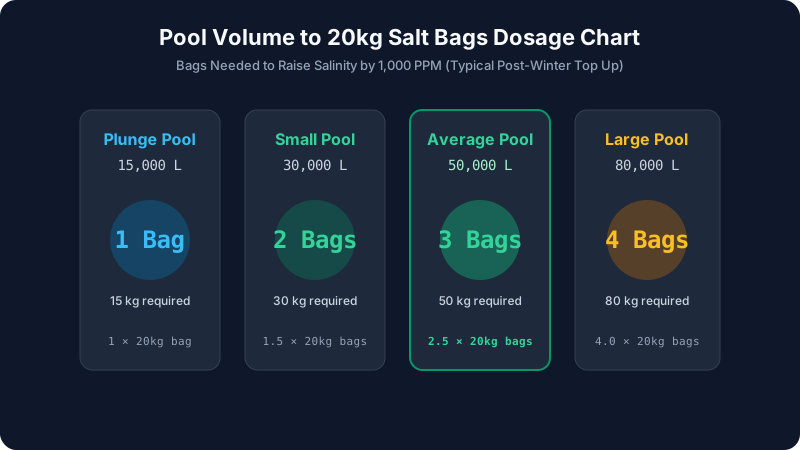
A 50,000-liter fibreglass pool in Brisbane tests at 2,700 PPM following heavy monsoon storms. The Zodiac chlorinator cell requires 4,000 PPM (a 1,300 PPM deficit). Applying the metric formula: Salt = [50,000 × 1,300] / 1,000,000 = 65 kg. Adding three 20kg bags plus 5kg of pure pool salt restores salinity to 4,000 PPM.
Manufacturer Salinity Target Comparison Matrix
| Chlorinator Brand / Model | Ideal Operating PPM | Low Salt Cutoff PPM | High Salt Warning PPM |
|---|---|---|---|
| Hayward AquaRite / T-CELL-15 | 3,200 PPM | 2,700 PPM | 4,000 PPM |
| Pentair IntelliChlor (IC20 / IC40) | 3,400 PPM | 2,800 PPM | 4,500 PPM |
| Zodiac LM3 / Tri Series | 4,000 PPM | 3,000 PPM | 6,000 PPM |
| Jandy AquaPure | 3,000 – 3,500 PPM | 2,500 PPM | 4,500 PPM |
| AutoPilot Pool Pilot | 3,000 PPM | 2,400 PPM | 35,000 PPM (Marine Cell) |
Resolving High Salt Overdosing and Ruthenium Scaling
Salt does not evaporate. When water evaporates under hot sun, pure H₂O leaves the pool while salt remains, naturally concentrating salinity. Adding too much salt cannot be remedied with chemical neutralizers. The sole method to lower pool salinity is partial draining and refilling with freshwater. Furthermore, high pH (above 7.8) combined with high salinity accelerates calcium carbonate calcification over the delicate ruthenium-coated titanium plates in your cell. Inspect cells every 90 days and soak in a 1:4 diluted muriatic acid bath only when visual scale buildup is present.